

Top 5 Warehouse Locations for 2-Day Delivery
Last Updated: May 5, 2026 | ⏱ 8 min
U.S. retail eCommerce sales hit $1.2337 trillion in 2025, and nearly 4 in 10 online shoppers now expect free two-day delivery. That's not a preference, it's a baseline. Miss that window, and customers abandon carts or simply buy from someone faster.
For eCommerce brands, warehouse location isn't just a real estate decision. It's a revenue decision. Choosing the best warehouse location in the US determines how many customers you can reach in two days, how much you'll pay in shipping costs, and whether you can compete with giants who've spent billions optimizing their fulfillment networks.
Luckily for you, shipping carriers price parcel services partly by zone distance, so the warehouse that sits closest to the largest concentration of customers usually wins on both transit time and cost. This guide breaks down the top five US warehouse locations for 2-day delivery, explains how to choose a warehouse location that matches your customer distribution, and shows you how warehouse location strategy can transform fulfillment from a cost center into a competitive advantage.
How We Ranked These Locations
We evaluated each region based on five critical factors that determine whether a warehouse location delivers fast, affordable two-day service:
Population Density: More people within reach means more customers served in shorter shipping zones.
Shipping Zone Efficiency: Proximity to dense population clusters reduces parcel zone counts, lowering costs and improving speed.
Port, Rail, and Highway Access: Strong freight infrastructure supports inbound inventory flow and outbound distribution.
Labor and Industrial Depth: Access to warehouse space, labor pools, and logistics expertise ensures operational scalability.
Network Fit: Usefulness as either a first warehouse node or a later expansion location for multi-node networks.
It's important to understand that too many warehouses can improve speed but still increase carrying and operating costs. For most brands, the smartest first warehouse is the one that gives the widest fast-delivery reach to the densest customer base. Additional nodes only make sense when order volume justifies the added complexity.
1. Northeast / East Coast

The Northeast and East Coast corridors offer the strongest opening move for brands that want dense demand, fast parcel reach, and access to multiple major metros inside a relatively compact geography.
The Northeast Census Region had 58.0 million residents in 2025. This concentration of population and economic activity creates unmatched parcel economics for two-day delivery.
States that make this work: Rhode Island, Massachusetts, Connecticut, New York, New Jersey, and Pennsylvania form an interconnected corridor where proximity to one major metro often means proximity to several others.
States within the Northeast Corridor, like Rhode Island, give brands access to one of the country's densest customer maps. Rhode Island Commerce highlights the state's strategic location on Interstate 95, plus access to air, rail, and port networks, demonstrating how even smaller Northeast states can provide brands with access to the wider corridor advantage.
Infrastructure proof: In CBRE's ranking of the top 100 U.S. industrial leases in 2025, the Pennsylvania I-78/I-81 corridor remained one of the leading logistics markets, with 4.5 million square feet among the top lease transactions. This shows the Northeast isn't just dense in population, it remains highly active in logistics real estate.
For import-heavy brands, the Port Authority's 2024 marine emissions inventory report confirms that the New York/New Jersey port complex moved 8.7 million TEUs in 2024, reinforcing the scale of the region's freight gateway infrastructure.
Which brands it fits best: eCommerce brands selling to East Coast customers, subscription box services targeting urban professionals, apparel companies needing fast Northeast delivery, and any brand choosing its first U.S. warehouse location.
For most brands building a one-warehouse strategy, the Northeast / East Coast deserves serious consideration as the foundation of a national fulfillment network.
Those interested in Northeast fulfillment should consider third party logistics providers to optimize and scale their operations. 3PLs like Coast to Coast Fulfillment are strategically located within the dense Northeast Corridor, giving brands access to affordable 1 to 2 day delivery to a large portion of the U.S. population. With custom pricing tailored to each client, you only pay for what you use while enabling the ability to scale your operation with a team dedicated to getting orders to your customers.
2. Midwest and Great Lakes

If the Northeast is the densest demand play, the Midwest is the balancing play. It gives brands a central node that can support nationwide distribution without leaning entirely on one coast.
The Midwest Census Region had 69.8 million residents in 2025, making it a substantial demand base on its own. But the real advantage comes from geography: Midwest hubs sit at the crossroads of major freight corridors, creating efficient reach to both coasts and the South.
Example markets: Chicago, Columbus, and Indianapolis represent the Midwest's logistics powerhouses.
Infrastructure proof: The Chicago Metropolitan Agency for Planning states that metropolitan Chicago is the nation's premier freight hub, with about 25% of all freight trains and 50% of all intermodal trains in the U.S. passing through the region. Some metro facilities handle more than 30,000 trucks per day, supporting both inbound inventory and outbound distribution at massive scale.
Industrial market proof: CBRE's 2025 top-lease report shows Chicago with 8.7 million square feet, Indianapolis with 6.5 million square feet, and Columbus with 6.4 million square feet among the top 100 U.S. industrial lease transactions. These aren't secondary markets but core logistics hubs where major brands and 3PLs continue investing heavily.
Columbus, in particular, has emerged as a serious Midwest contender. The Columbus metro reached 2.242 million residents in 2025, and its central location provides excellent balance for brands thinking beyond Chicago's higher costs.
Which brands it fits best: Brands seeking nationwide balance, companies with evenly distributed customer bases across multiple regions, B2B wholesalers serving the Midwest and Great Lakes, and brands looking to complement an existing coastal warehouse with central reach.
The tradeoff: The Midwest offers better national balance than the Northeast, but not the same concentration of high-density East Coast demand. For brands with heavily Northeast-focused customer bases, a Midwest-only strategy may increase shipping costs to your largest market.
If your customer map skews evenly across regions or you need a second node to balance an East Coast warehouse, the Midwest delivers reliable central coverage at competitive costs.
3. Southeast

The Southeast is no longer just a secondary warehouse option. For many brands, it's one of the fastest-growing regional market in the country and a smart complement to an East Coast or Midwest node.
The South Atlantic Census Division had 70.2 million residents in 2025, reflecting decades of population migration to Sun Belt states. This growth, combined with improving freight infrastructure and expanding industrial capacity, makes the Southeast increasingly attractive for warehouse location strategy.
Example markets: Atlanta and Savannah anchor the Southeast's logistics network.
Freight proof: Savannah's port handled nearly 5.6 million TEUs in 2024, up by roughly 618,000 TEUs from 2023. The Georgia Ports Authority reported this made Savannah the fastest-growing container port on the U.S. East and Gulf coasts, underscoring the region's importance for inbound freight flow.
Population proof:Georgia had a 2025 population estimate of 11.3 million, reinforcing the "growing Southeast demand base" narrative that's reshaping fulfillment networks.
Industrial market proof:CBRE's 2025 top-lease ranking placed Atlanta at 6.6 million square feet among the top 100 U.S. industrial lease transactions, showing that the market remains one of the country's big-box logistics leaders.
Which brands it fits best: Brands with strong Southeast customer concentrations, companies expanding into Sun Belt markets, import-heavy businesses leveraging Savannah's port growth, and brands seeking alternatives to Northeast warehousing while maintaining strong, competitive East Coast service.
The tradeoff: The Southeast excels for Sun Belt reach and East/Gulf freight access, but if your customer base is heavily concentrated in the Northeast, it still makes sense to prioritize the Northeast first. The Southeast works best as a complement, not a replacement, for brands with significant Northern demand.
For growth-focused brands targeting the Southeast or looking to diversify away from purely Northeast networks, this region delivers fast expansion at competitive costs.
4. South Central and Texas

Texas and the South-Central region represent the best growth-and-resilience play for brands that want access to the South, Southwest, and Gulf while diversifying away from purely coastal networks.
Texas had a 2025 population estimate of 31.7 million, making it one of the largest demand centers in the country by itself. That's larger than many entire regions, which means a Texas warehouse serves significant in-state demand while also functioning as a distribution platform for surrounding states.
Example markets: Dallas-Fort Worth and Houston dominate Texas logistics.
Freight proof: Port Houston reports that the Houston Ship Channel complex is the nation's largest port for waterborne tonnage, supports 1.54 million jobs in Texas and 3.37 million jobs nationwide, and remains the largest Gulf Coast container port, handling 75% of U.S. Gulf Coast container traffic. These are powerful stats demonstrating the region's freight gravity.
Industrial market proof: CBRE's 2025 top-lease report ranked Dallas-Fort Worth third nationally, with 8.3 million square feet among the top 100 industrial lease transactions. This confirms Texas as a major warehouse cluster, not just a population story.
Which brands it fits best: Brands with significant Texas and Southwest customer bases, companies importing through Gulf Coast ports, businesses seeking central-southern distribution, and brands diversifying warehouse networks to reduce coastal concentration risk.
The tradeoff: A single Texas node usually doesn't match the Northeast for dense East Coast parcel economics, which is why it's better framed as a complementary national hub or a strong fit for brands whose customer maps skew heavily toward the Sun Belt and Southwest.
Texas isn't just a big market, but a distribution platform. For brands balancing growth, resilience, and access to Gulf freight infrastructure, Texas delivers outsized value.
5. West Coast and California

The West Coast, anchored by Southern California's Inland Empire, represents the best regional node for Asia-Pacific-heavy import flows and brands with concentrated western demand.
California's 2025 population estimate was 39.3 million, so large that the state can justify a warehouse strategy on demand alone for many brands. But the real advantage comes from port access: Southern California serves as the primary entry point for goods manufactured in Asia.
Example markets: The Inland Empire, Los Angeles, and Long Beach form the West Coast's logistics backbone.
Port volume proof:The Port of Los Angeles reported that its calendar-year 2025 cargo volume topped 10.2 million container units, its third-best year ever. The Port of Long Beach reported 9.8 million TEUs in 2025, a new record. Together, these two ports handle more containerized cargo than any other gateway in the Western Hemisphere.
Industrial market proof: CBRE reported that the Inland Empire led the nation in large industrial leases in 2025, with 14 of the top 100 U.S. industrial leases totaling 11.8 million square feet. This is the clearest available statistic supporting Southern California's role as the country's premier distribution hub on the West Coast.
Which brands it fits best: Import-heavy brands sourcing from Asia, companies with heavily West Coast-focused customer bases, businesses requiring proximity to Los Angeles/Long Beach ports, and brands needing rapid access to California's massive consumer market.
The tradeoff: If your inventory enters through Pacific gateways or your customers skew heavily west, Southern California can be a powerhouse. But for a one-node national strategy, it's usually better as a complement to an East or Midwest network than as the only warehouse. Shipping costs to serve the densely populated East Coast from California erode margins quickly. Additionally, internal costs such as land and labor are typically higher, further compressing margins and making it harder to stay competitive on both pricing and delivery speed.
Southern California remains essential for West Coast-focused brands and import-heavy operations, but it's rarely the optimal choice as a first and only warehouse for national two-day delivery.
How to Choose the Right Warehouse Location for Your Brand
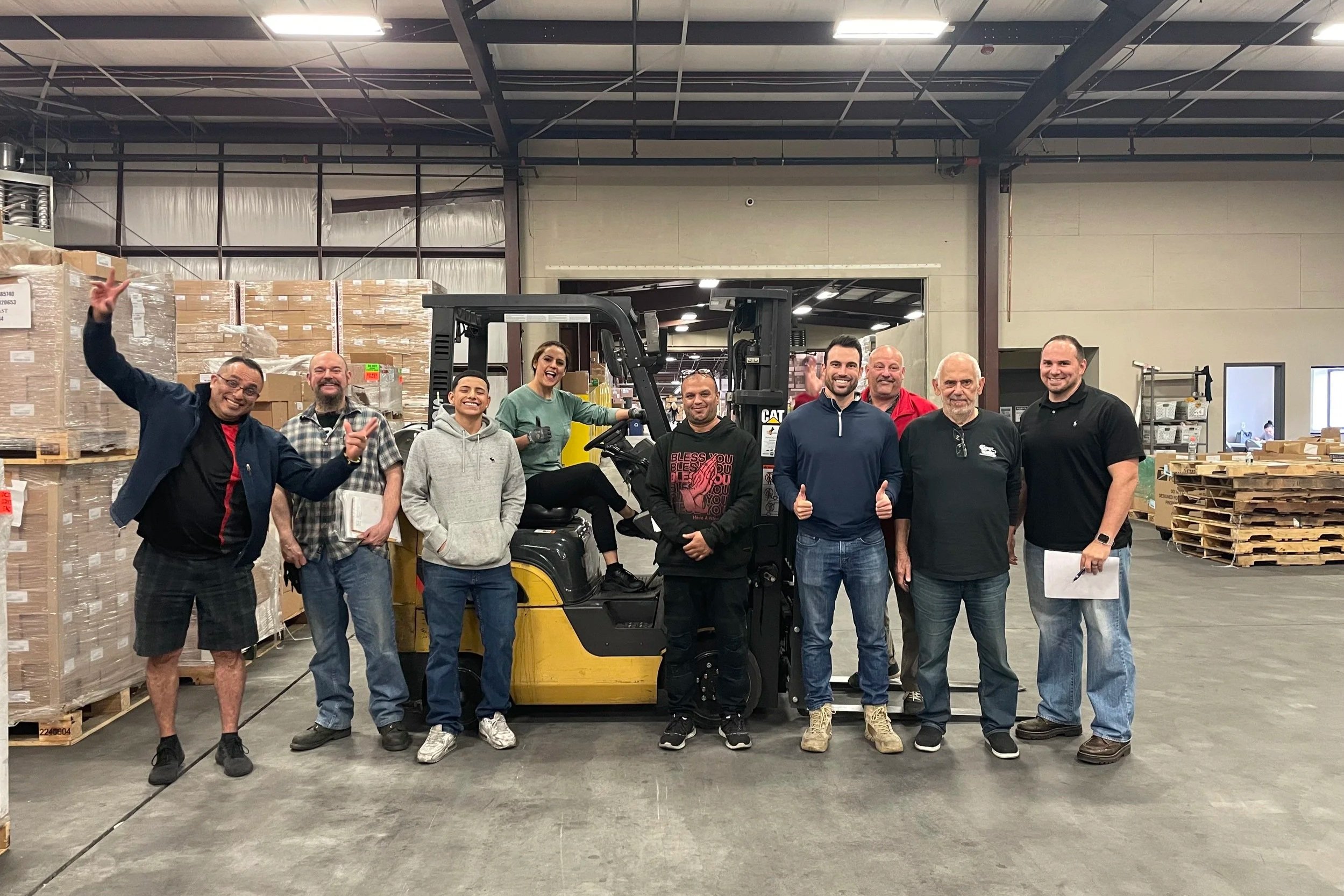
The "best" warehouse location isn't universal, it's the one that aligns with your specific customer distribution, order volume, and growth strategy.
Start by analyzing your current order map. Where do most of your customers live? If your orders often ship to the Northeast and Mid-Atlantic, a Rhode Island or Pennsylvania warehouse puts you closer to your largest customer base, reducing both transit time and shipping costs.
If your customer distribution is more evenly spread, a Midwest hub like Columbus or Chicago provides better national balance. For brands with concentrated West Coast demand or Asia-heavy import flows, Southern California could make sense despite higher costs.
For growing brands considering multi-node networks, the typical expansion pattern follows population density: start in the Northeast and add a second node in the opposite region to improve national coverage, then consider Southeast, Texas, or Mid-West Coast nodes based on customer concentration and import logistics.
Coast to Coast Fulfillment operates from Rhode Island, positioning us at the heart of the Northeast Corridor. The densest customer map in the United States. Our strategic location on Interstate 95 provides access to Boston, New York, Philadelphia, and Washington, D.C., with 1–2-day ground delivery reaching approximately 40% of the U.S. population. For brands prioritizing fast East Coast delivery and efficient parcel economics, our Northeast location delivers measurable advantages in speed and cost.
Ready to optimize your warehouse location strategy? Evaluate your current order distribution, compare shipping zones from different regions, and consider how warehouse placement affects both customer experience and your bottom line.
Contact Coast to Coast Fulfillment today to learn how our Rhode Island facility and Northeast expertise can help you achieve faster delivery at lower shipping costs.
FAQ
-
The best warehouse location depends on your customer distribution, but the Northeast and East Coast corridor often delivers the strongest results for brands prioritizing national two-day delivery. The Northeast Census Region contains 58 million residents, includes four of the 10 largest U.S. metros, and generates 20% of national GDP. States like Rhode Island, Pennsylvania, and New Jersey provide access to dense population clusters with efficient shipping zones.
-
To choose a warehouse location, analyze your order map to identify where most customers live, evaluate shipping zones and transit times from potential warehouse locations, consider freight infrastructure (ports, rails, highways) for inbound inventory, assess warehouse availability and labor costs in target markets, and plan for future expansion if you'll eventually need multiple warehouse nodes. The goal is to position inventory closest to your largest customer concentrations.
-
Key factors include population density within two-day ground shipping range, shipping zone efficiency to minimize carrier costs, access to freight infrastructure for receiving inventory, warehouse availability and competitive leasing rates, labor pool depth and logistics expertise, and strategic fit as either a first node or expansion location. The best location balances customer proximity, operational costs, and scalability.
-
The Northeast offers the densest concentration of U.S. consumers in a compact geography. The region contains 58 million residents, four of the 10 largest metros, and generates 20% of GDP. The New York/New Jersey port complex handles 8.7 million TEUs annually, providing strong import infrastructure. Interstate 95 connects major cities from Boston to Washington, D.C., enabling efficient distribution. This combination of population density, freight access, and logistics infrastructure makes the Northeast exceptionally strong for two-day delivery.
-
Most brands should start with one strategically located warehouse that serves their densest customer concentrations. A single Northeast or Midwest warehouse can reach 70-80% of U.S. consumers in two days via ground shipping. Add additional warehouse nodes only when order volume justifies the increased complexity, carrying costs, and operational overhead. Multi-node networks improve speed but require significant volume to offset the costs of split inventory and additional facilities.
-
Shipping carriers price parcel services based on zone distance—the farther a package travels, the more it costs. A warehouse located closer to your customers reduces average zone counts, lowering per-package shipping costs significantly. For example, shipping from the Northeast to Boston costs less than shipping from California to Boston because the package travels through fewer zones. Warehouse location strategy that minimizes average shipping zones can reduce fulfillment costs by 15-30% compared to poorly located facilities.